
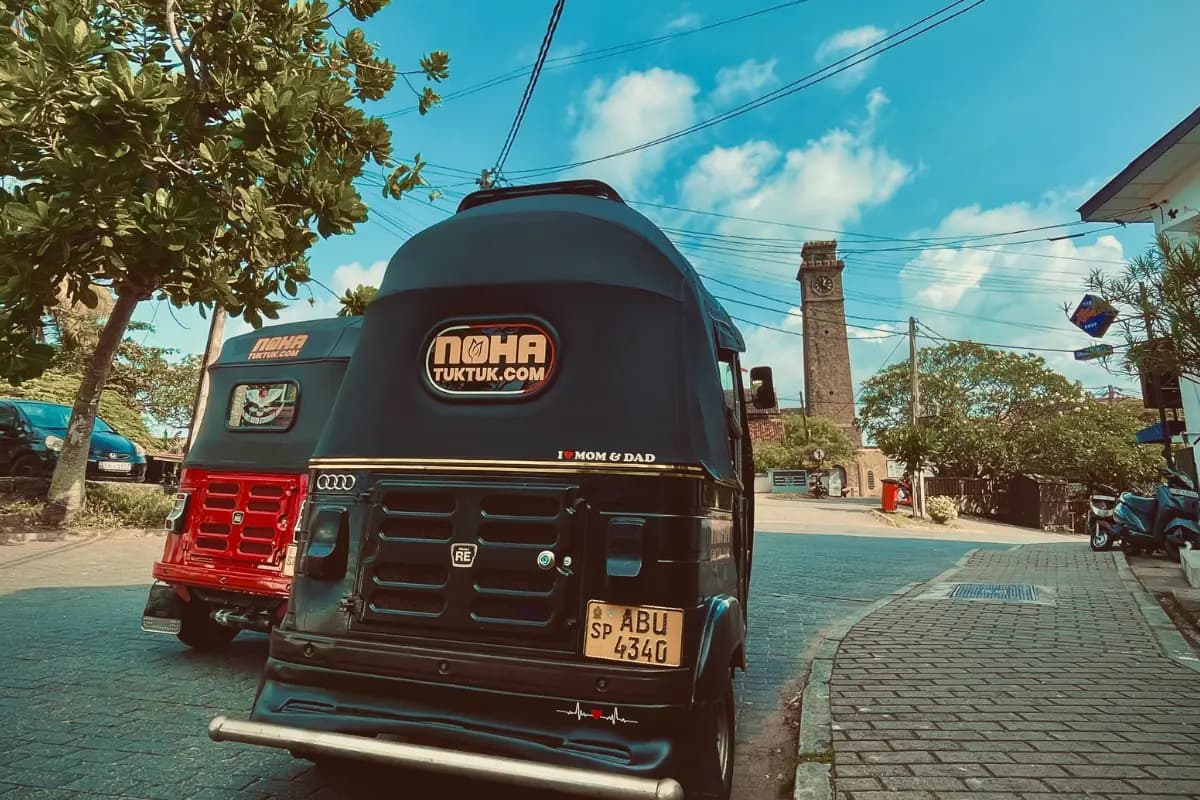
Daniel and his group were on the coast road out of Galle when the tuk tuk got a flat tire. He messaged NOHA. Someone got in a car, drove out with a spare wheel, and swapped it at the roadside.
That's a more honest answer to "is it safe" than any list of features. A flat tire isn't a safety failure — it's a normal thing that happens on Sri Lankan roads, some of which are in better shape than others. What matters is what happens next: whether you're stuck, or whether someone shows up.
Short answer: yes — renting a tuk tuk in Sri Lanka is safe, with the same ordinary caution you'd use on any local road, plus a permit that's actually legal, insurance that's actually included, and a support line that actually answers. The rest of this page is the honest version, with real numbers instead of vibes.
What you're actually driving into
Sri Lanka drives on the left. Roads outside the main towns mix tuk tuks, buses, motorbikes, dogs, and the occasional cow, often on a road with no painted lane markings at all. A tuk tuk tops out well below car speed — the legal limit is 40 km/h — so the vehicle itself isn't the fast-moving part of the equation. The traffic around you is the bigger adjustment, not the driving.
One thing that catches first-timers off guard: the horn. In Sri Lanka it's used constantly, and it means "I'm here," not "get out of my way." A tap before a blind bend or before overtaking is normal driving, not road rage — once that clicks, the traffic stops feeling chaotic and starts feeling like a system with its own logic.
Tuk tuks aren't permitted on Sri Lanka's expressways, so you won't be merging with highway-speed traffic — you'll be on the A-road and B-road network instead, generally well maintained along the main coastal and southern routes, more variable once you're inland. Potholes, pedestrians stepping into the road, and animals crossing without warning are the real day-to-day hazards, not other vehicles. We'd also steer you away from driving after dark: street lighting is sparse outside the main towns, and the same obstacles are a lot harder to see coming.
The honest numbers, and what they mean for you
The World Health Organization's most recent estimate puts Sri Lanka's road fatality rate at 11.5 deaths per 100,000 people (2021 data) — below both the South Asia average (around 16.1) and the wider Asia-Pacific average (around 15.2). Sri Lanka's roads aren't risk-free, but by the region's own numbers, they're not an outlier either.
Sri Lanka's Police Motor Traffic Department recorded roughly 22,900 accidents and 2,243 deaths in 2024. Motorbikes and three-wheelers together account for close to half of all recorded accidents nationally, according to the National Council for Road Safety — but that figure is dominated by motorbikes, which travel well above a tuk tuk's 40 km/h cap and carry no bodywork around the rider at all. A tuk tuk is a structurally slower, more enclosed vehicle than the number suggests if you don't separate the two.
More useful than the vehicle-type breakdown: Sri Lanka's Ministry of Transport attributes 60–70% of accidents to undisciplined driving, not to vehicle defects or road conditions. That's the actual lever. It's why every rental includes a driving introduction lesson before you set off, not just a key handover — the biggest risk factor is behaviour, and behaviour is the one thing a proper briefing can genuinely change. If anything still feels unfamiliar once you're on the road, that's what the 365-day WhatsApp line is for — a quick voice note gets you an answer faster than a search engine would.
Where the real hazards are
In town — Colombo, Kandy, and Galle all get properly congested. A tuk tuk is small and maneuverable enough to be an advantage here, but busy junctions reward patience over speed. Parking is the other upside: a tuk tuk fits into gaps a car never would, which matters in Galle Fort's narrow lanes or any town centre where kerb space runs out fast.
Hill country — the roads up to Ella and Nuwara Eliya are well paved but steep and winding, with plenty of blind bends. Second gear on the descents keeps you in control without riding the brakes the whole way down — a tuk tuk's low top speed is actually a genuine advantage on this kind of road, not a limitation.
Monsoon season — Sri Lanka has two: the southwest monsoon (roughly May–September) affects the west and south coast, including Galle, while the northeast monsoon (roughly October–January) affects the east coast and hill country. Heavier rain means standing water and, in the hills, occasional landslide-related road closures — worth a quick check of conditions before a hill-country day trip in that window. Wet tarmac also lengthens stopping distance more than it looks like it should, so we'd rather you get to Unawatuna ten minutes late than take a bend at the speed you'd take it dry.
Checkpoints — police checkpoints on the main routes are routine, not a sign anything's wrong. Slow down, and have your passport and AAC permit ready to show — most stops for tourists are a quick look and a wave through. This is the other reason the permit isn't optional: turning up without one turns a thirty-second stop into a genuinely bad afternoon.
What's included to cover you
Full insurance
Included on every rental, no extra charge.
Driving introduction lesson
Before you set off, every time.
365-day support
WhatsApp support and roadside help, every day of the year.
Every tuk tuk also carries a spare wheel and a full tool kit as standard, plus a first aid kit, a phone holder, and unlimited kilometres — see the full tuk tuk rental in Sri Lanka page for the complete list and current pricing.
The permit isn't optional
Only the AAC permit covers a tuk tuk — the DMT permit, available at the airport, does not extend to three-wheelers. Driving without the right permit isn't a grey area, and it's the one part of "is this safe" that's actually about paperwork, not roads. We handle the AAC application before you arrive — see the full AAC vs DMT permit comparison for fees and validity.
Is a tuk tuk the right call?
For most travellers, yes — it's why it's the most-rented vehicle we have. If you've never driven one before, that's the normal case, not the exception: the driving lesson exists precisely for that. It comfortably seats two with luggage behind the seat, and loading it evenly matters more than people expect — a top-heavy pile of bags changes how a three-wheeler handles on a bend, so we'll show you how to pack it during the lesson, not leave you to work it out on the road.
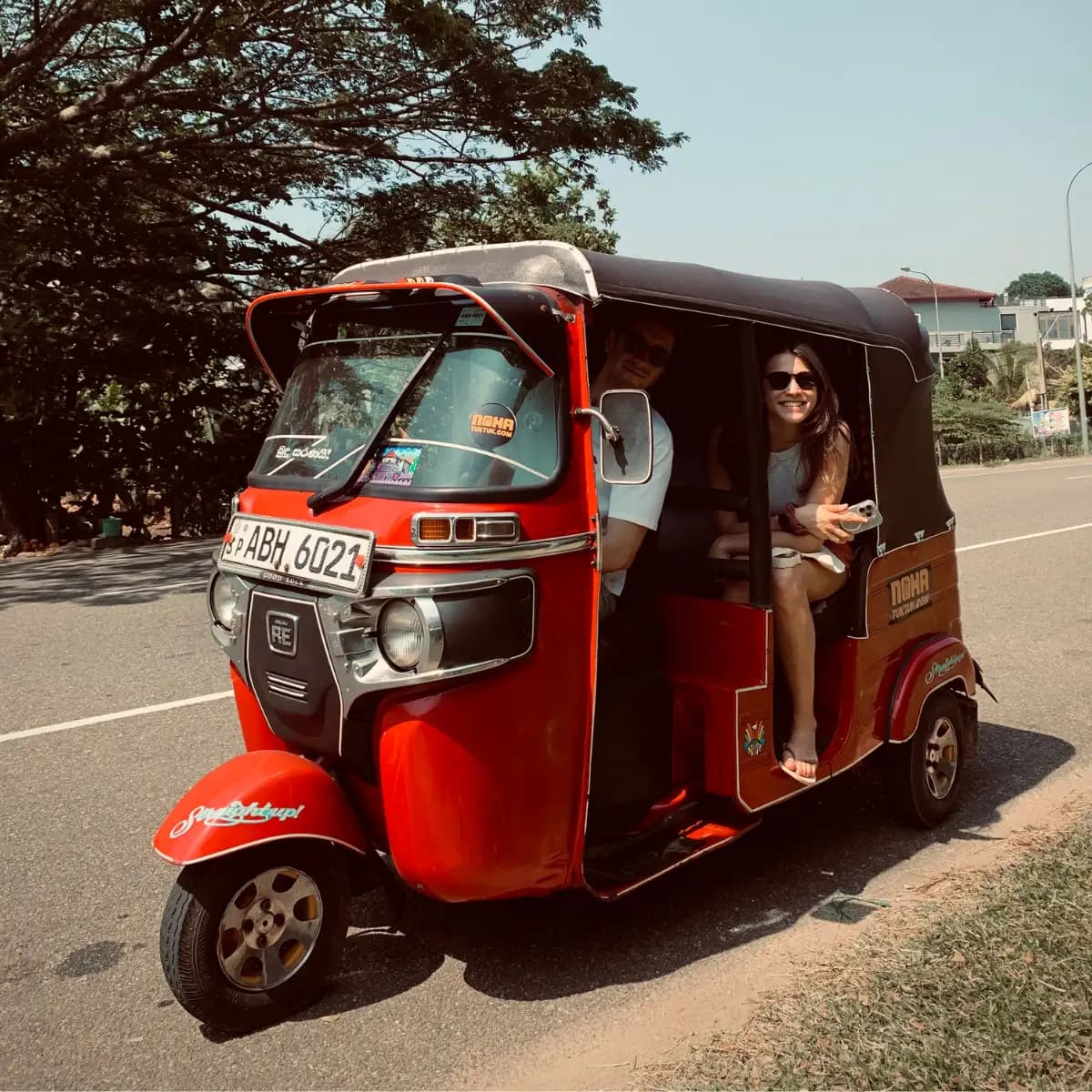
A few situations where it's worth pausing. We don't carry child seats, so if you're travelling with young children, a self-drive car is the honest recommendation instead. If your trip is mostly long, direct stretches — Colombo to Galle in one push, say — remember tuk tuks can't use the expressway, so that route takes considerably longer by tuk tuk than by car; a scooter or car might suit a tighter schedule better. And if a rougher ride or open-air seating is a real concern — a bad back, for instance — say so when you message us; we'd rather point you toward the right vehicle than have you find out on the road.
Solo travellers, including solo women, rent from us regularly — it's not a niche case. The same basic precautions that apply anywhere apply here: stick to daylight driving, keep your phone charged, and let someone know your route for longer day trips. None of that is specific to a tuk tuk; it's just ordinary sense on any unfamiliar road, and the 365-day WhatsApp line is there either way.
Numbers worth saving before you set off
Sri Lanka's emergency numbers work from any phone, no local SIM required. Save these alongside our own number before you leave:
- Police: 119 (or 118)
- Ambulance / Fire & Rescue: 110
- Suwasariya ambulance: 1990
- Tourist Police (English-speaking): +94 11 242 1052
- Tourism Hotline: 1912
- Government Information Centre: 1919
- NOHA TUKTUK, 24/7: +94 76 1219 757 on WhatsApp
So — is renting a tuk tuk safe?
Sri Lanka's roads are real roads, with real potholes and real traffic — not a curated tourist experience. But the numbers put that in context: a fatality rate below the regional average, and a Ministry of Transport that itself points to driver behaviour, not the vehicle, as the main factor in most accidents. A tuk tuk's low speed cap and open, forgiving handling work in your favour there, not against you.
What none of this does is make the roads perfect. It means that when something ordinary goes wrong — a flat tire, a wrong turn, a question about a checkpoint — there's a legal permit already sorted, insurance already in place, and someone who picks up. Daniel's flat tire got fixed at the roadside in under an hour. That's the realistic version of "safe," and it's the one we've built the rental around.